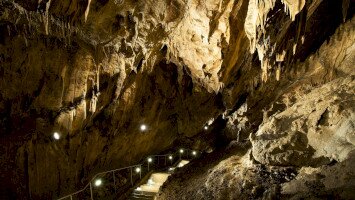
At the end of the Pleistocene, around 130 thousand years ago, several caves in the Bükk provided shelter for the people living there. The Bükk region and its immediate surroundings were elevated to the ranks of the world's most significant Paleolithic sites due to the favorable conditions for settlement. The advantageous geographical conditions, the spring and autumn migrations of herbivorous animals, the game-rich hilly area, and the proximity of easily usable raw materials provided excellent conditions for habitation. In the mountains, 46 caves have been identified that yielded evidence of some archaeological culture, and in nearly every cave, multiple cultures settled over the course of time. The most significant prehistoric caves open to the public are the Szeleta Cave, the Istállós Cave, and the Suba Hole. The "Bükk Prehistoric Caves" have been part of the Hungarian Heritage Register since November 2025.
Located on the side of the Hór Valley, near Cserépfalu, is Suba Cave, whose significance comes from the remains of prehistoric humans of various ages and from an almost complete sequence of layers spanning the last phase of the Ice Age. In the cave fill, averaging 6 meters thick, the skeletal remains of a Neanderthal, a 25–35-year-old woman, and a child around 3 years old were found, alongside numerous animal bones, flint tools, and charcoal fragments indicating the use of fire. The animal bones found in the cave prove that the people who lived here hunted not only in the forest but also on the grassy plains stretching in front of the Bükk Mountains. The most common bones belong to cave bears, wild horses, chamois, ibex, hares, red deer, and mammoths. The vast majority of their stone tools were made from locally collected materials; however, objects made of quartz porphyry from present-day Bükkszentkereszt and obsidian of Zemplén origin were also found.
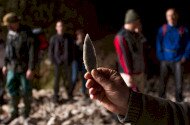
From the largest habitable cave in the region, the Szeleta Cave, exquisitely crafted leaf-shaped flint spearheads were discovered in 1907. Later research established that the cave was inhabited for about 100,000 years, from the Bábonyi culture to the Late Szeleta culture. The cave is the type site of the Szeleta culture. Its significance is also due to the fact that two rock sources important for tool-making are located nearby (Miskolc–Avas and Bükkszentlászló–Tatár-árok).
Perhaps the most frequently visited prehistoric cave in the Bükk is the Istállós-kő Cave, which opens at an elevation of 546 meters in the upper section of the Szalajka Valley. During the first excavation in 1913, aside from stone tools and ceramic finds, the collarbone of a 3-year-old child who lived at the end of the Pleistocene era was also discovered. In later excavations, a Neolithic hearth pit was uncovered at the entrance of the cave, yielding shell jewelry, pottery fragments, and evidence of ritual cannibalism in the form of charred human bones. According to some experts, the cave may have been a site of sacrifices, and the Stone Age settlement may have been located in what is now the area of Szilvásvárad.