Count Adam Keglevich established an iron hammer mill at Szilvásvárad in 1792, and then he set up a smelting furnace based on the iron ore of Mária mine at Bélapátfalva and St.Anne Mine in the Gilitka Valley explored between 1801 and 1803.The iron smelter lasted until 1848, and the operation of the iron hammer mill lasted until the early 1870s.
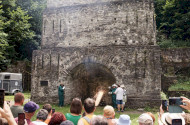
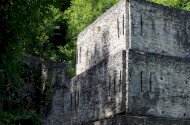
However, the choice of the location of the blast furnace at Ómassa proved unfortunate: it was built too close to the stream, and the wet soil hindered production.As early as 1777, it was planned to move the smelter, but this did not happen until 1813, when the ancient smelter, still visible as an industrial monument, was built at Újmassa.The factory proved viable and until 1868 they worked with only charcoal.The plant then moved to Diósgyőr under the management of the Hungarian state, and through state orders it became one of the largest heavy industrial factories in Hungary in the 19th and 20th centuries.
For the smelter installed at Ómassa by Henrik Fazola and his son Frigyes, and then for the blast furnace at Újmassa, the raw material for iron production was supplied from outside the mountains in a significant amount, from the hydrothermal-metasomatic ore of the Upponyi Mountains.
Iron manganese ore in the sandstone and slate series of Uppony Mountains was exposed by more than 20 shafts and adits, as well as tens of open-pit mines.The total known length of the cuts explored so far (Lower and Upper Mihály Shaft, Lower and Upper Rigós Shaft, Henrik Shaft, Frederick Shaft, Zsófia Shaft, Lajos Shaft, Bóti Valley Shaft, Malomgát Shaft) is nearly 600 metres.
As a result of forest management booming at the turn of the 19th and 20th centuries, narrow gauge railway lines were constructed.At the initiative of landowner Gábor Wessely, the idea of a narrow gauge rail for exploring the almost impenetrable forests of the Bükk Plateau and extracting trees was born in 1908.The narrow gauge train of Szalajka Valley – Tótfalu Valley, connecting to the Eger–Szilvásvárad–Putnok MÁV (Hungarian Railway) line, was already in operation in 1910.The track branching out of the Szalajka Valley line reached its end point at an altitude of 600 m a.s.l.in Kukucsó Valley via the single track reversal turn at the peak.It was connected with the Bükk Plateau light rail (Káposztáskert-lápa – Őserdő main line) constructed in the meantime by a double track cable car railway.The branch line to Bánkút was constructed around 1930.The steel rail track to Csalános in Huta Meadow was in operation until the 1960s, while the ancient forest track ceased to exist as early as the 1940s.
The first line of the Garadna-Szinva narrow gauge rail (Szinva Valley Forest Railway, later Lillafüred State Forest Railway), the Miskolc-Fáskert-Garadna section was built in 1919–1920 to ensure the industrial wood needs of the post-Trianon country.With the construction of the branch lines (e.g.Miskolc-Mahóca line to the northern foot of Örvény-kő, along around 19 kilometres), the extension of the main line and some other branch lines for logging increased the length of the railway network until 1947.
The narrow gauge railway network around Felsőtárkány was created in World War I: in order to meet the increased wood demand, the horse-tow track was built in the Hideg-kút Valley in the Archdiocese Lordship Forest of Eger in 1915.Following this, branch lines (Vörös-kő Valley, Kós Valley, Mellér Valley, Barát Valley, Vár Hill dolomite quarry, etc.) were built one after the other.Nowadays only the 5 km section between Felsőtárkány and Stimecz house (State Forest Railway of Felsőtárkány), which serves tourism only reminds of the once extended narrow gauge rail network.